The Winger Factory: How One Tiny Colombian Club Became the World's Most Efficient Transfer Machine
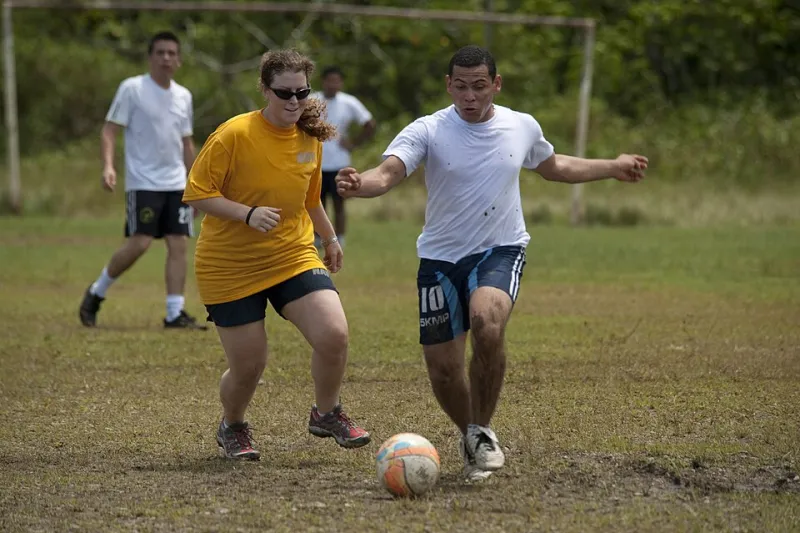
Photo: Official Navy Page from United States of America MC1 Brien Aho/U.S. Navy, Public domain, via Wikimedia Commons
The Winger Factory: How One Tiny Colombian Club Became the World's Most Efficient Transfer Machine
In the sprawling metropolis of Bogotá, tucked away in a modest training facility that wouldn't pass inspection at most American high schools, lies the most efficient transfer operation in world soccer. Independiente Santa Fe — a club most American fans couldn't locate on a map — has quietly revolutionized the business of producing and selling wide attackers.
 Photo: Independiente Santa Fe, via upload.wikimedia.org
Over the past four years, this unassuming Colombian outfit has generated more than $47 million in transfer revenues from winger sales alone, a figure that dwarfs the annual operating budgets of several MLS clubs. Their secret isn't superior facilities, cutting-edge technology, or astronomical youth budgets. It's something far more elegant: a systematic approach to identifying, developing, and marketing a specific type of player that the global market desperately craves.
The Philosophy Behind the Factory
Santa Fe's transformation began in 2022 when technical director Carlos Restrepo made a radical observation: while European clubs obsess over central midfielders and strikers, the market for explosive wide attackers remained chronically undersupplied. Rather than competing with established academies for the next generational midfielder, Santa Fe would corner the winger market.
"We studied transfer data for three years," Restrepo explains via video call from Bogotá. "Wingers who could beat defenders one-on-one were selling for premiums of 40-60% over players in other positions. The market was screaming for this profile, but nobody was systematically producing it."
The club's approach defies conventional wisdom about youth development. Instead of casting a wide net across multiple positions, Santa Fe recruits exclusively for pace, dribbling ability, and tactical intelligence in wide areas. Every player in their academy system — regardless of their eventual position — spends at least two years training as a winger.
This specialization creates what economists call network effects. As Santa Fe's reputation for producing elite wide attackers grows, more talented young players seek out their program specifically. The club now receives over 2,000 applications annually for just 40 academy spots.
The Numbers Game
The statistics are staggering. Since 2022, Santa Fe has sold 11 wingers to European clubs for an average fee of $4.2 million — remarkable for players developed at a facility that costs less than $800,000 annually to operate. Compare this to the average MLS academy, which spends approximately $3.2 million yearly while producing transfer revenues averaging just $1.8 million.
Their most successful graduate, left winger Miguel Torrealba, joined Sevilla for €8.5 million in January 2026 after just 18 months in Santa Fe's first team. The club retained a 20% sell-on clause, meaning they'll earn additional millions when Sevilla inevitably moves him to a bigger club.
"The European market pays premiums for players who can create width and beat defenders in isolation," explains transfer market analyst Jennifer Rodriguez, who tracks South American player movements for ESPN. "Santa Fe identified this market inefficiency and built their entire operation around exploiting it."
The club's success rate is equally impressive. Of the 23 wingers they've promoted to senior football since 2022, 19 have secured professional contracts in Europe or MLS. This 83% success rate far exceeds industry standards, where typical academy graduation rates hover around 12-15%.
The American Connection
MLS clubs have become crucial customers in Santa Fe's business model. American teams, desperate for attacking width and increasingly comfortable with South American talent, represent approximately 35% of Santa Fe's transfer revenues.
FC Dallas signed Colombian winger Andrés Peña from Santa Fe for $3.1 million in March 2026, immediately plugging a hole in their attack that had persisted for two seasons. Peña's impact was immediate: 7 goals and 11 assists in his first 20 MLS appearances.
"American clubs are finally understanding that you don't need to pay European prices for European players," notes MLS scout Roberto Martinez, who has evaluated multiple Santa Fe prospects. "These Colombian wingers arrive with technical skills that match anything in Europe, but at 60% of the cost."
The cultural fit proves equally important. South American players adapt more easily to MLS's physical style and diverse locker rooms than their European counterparts, while the salary structures in American soccer allow these players to earn life-changing money without the pressure of Champions League expectations.
The Training Ground Innovation
Santa Fe's facility resembles a laboratory more than a traditional training ground. Every practice session involves detailed video analysis, with players reviewing their touches, positioning, and decision-making in real-time. The club employs three full-time video analysts — an extraordinary investment for a team operating on less than $2 million annually.
The tactical preparation focuses obsessively on scenarios these players will encounter in Europe and MLS: how to receive the ball under pressure from Premier League fullbacks, when to dribble versus when to cross against Bundesliga defensive systems, how to exploit space in MLS's increasingly sophisticated tactical setups.
"We don't just develop players," explains youth coach Patricia Morales. "We develop players who understand exactly what European and American coaches want from their wide attackers."
This specificity extends to physical preparation. Santa Fe's conditioning program replicates the demands these players will face in more athletic leagues, emphasizing explosive acceleration and repeated high-intensity sprints that mirror Premier League and MLS playing styles.
The Negotiation Masterclass
Perhaps most impressively, Santa Fe has mastered the art of transfer negotiations. The club employs former European agents who understand exactly how to structure deals that maximize long-term revenue.
Every sale includes carefully crafted sell-on clauses, appearance bonuses, and performance incentives that continue generating revenue years after the initial transfer. When former Santa Fe winger Luis Cardona moved from Ajax to Manchester United for €25 million in 2025, Santa Fe earned €3.2 million from their 15% sell-on clause.
"They negotiate like a major European club despite operating like a small South American team," observes transfer expert Maria Santos. "It's the perfect combination of local development costs with international business sophistication."
Lessons for American Soccer
Santa Fe's success offers crucial insights for American clubs struggling with youth development economics. Rather than attempting to compete across all positions, specialization creates competitive advantages that justify premium pricing.
Several MLS academies are already studying Santa Fe's model. Orlando City has restructured their youth program to emphasize attacking midfielder development, while Real Salt Lake is focusing exclusively on central defender production.
"The Santa Fe model proves that you don't need to be everything to everyone," explains MLS technical development director Sarah Chen. "Focus on what you do best, do it better than anyone else, and the market will reward you accordingly."
The Sustainability Question
Critics question whether Santa Fe's model remains sustainable as competition increases. Other Colombian clubs are attempting to replicate their approach, while European academies are beginning to prioritize winger development more systematically.
Restrepo remains confident: "We have a four-year head start and relationships throughout the global market. By the time competitors catch up, we'll have evolved to the next level."
That next level involves expanding into women's soccer, where the market for explosive wide attackers remains even more underserved. Santa Fe's women's academy, launched in 2025, has already attracted interest from NWSL clubs seeking affordable alternatives to European talent.
For American fans, Santa Fe represents something profound: proof that smart, systematic approaches to player development can compete with unlimited budgets. In a sport increasingly dominated by financial resources, intelligence and specialization remain the great equalizers.
The tiny Colombian club that nobody knew has become everybody's favorite discovery — and their success story is just beginning.